

The Yips Start in Your Head, Not a Faulty Putter.
Here’s How We Help You Get Past Them.
If you roll the ball effortlessly in practice, but your hands jerk, twitch, or freeze the moment a putt matters on the course, you are dealing with the yips, and you are not alone. You can work one-on-one with Dr. Cohn’s team of certified mental performance coaches on a video call from wherever you live. For more than 40 years, Dr. Cohn and his team have coached golfers on the PGA Tour, the LPGA Tour, and at every level below through this exact problem.
What Causes the Putting Yips?
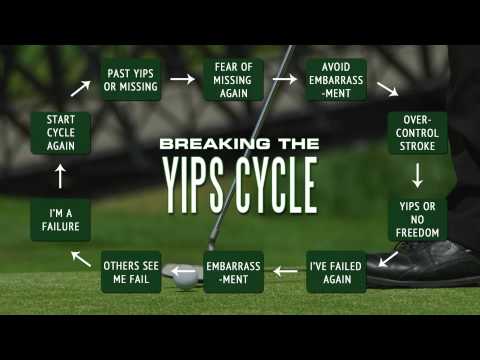
The putting yips show up as jerks, twitches, or a sudden freeze during the stroke, almost always when the putt means something. Most golfers blame their technique or their putter. In our experience, the problem is mostly mental: under pressure, the golfer starts steering the stroke consciously, and the smooth, automatic motion they trained for falls apart. Research and years of coaching point to a mental and neurological breakdown in automatic movement, not a flaw in your mechanics.
Dr. Patrick Cohn, founder of Peak Performance Sports, has coached PGA Tour and LPGA Tour players through the yips. His mental performance coaching system gives you a clear plan to get your putting back. Want quick answers first? Read our Golf Yips FAQ.
Coaching tour pros and everyday golfers for 40+ years · Worldwide by video call
Call 407-909-1700
Does This Sound Like Your Putting?
You don’t need to play professionally to get the yips. They show up at every level of the game. Which of these sound like you?
→ “My hands twitch or jerk on their own as I make contact with the ball.”
→ “I roll it fine on the practice green, then tighten up on the course.”
→ “Short putts scare me more than long ones.”
→ “New grips, stances, and putters haven’t helped.”
→ “I’ve started to wonder if I should quit golf.”
Do You Really Have the Yips?

Not every golfer gets the putting yips. Research from the Mayo Clinic suggests roughly one in three serious golfers will deal with them at some point.
The risk climbs with years in the game: golfers who have played for 30 years or more are the most likely to develop the yips, while many young golfers putt with a fearless, almost childlike mindset and rarely get them. Still, about half of all golfers never get them at all.
Just don’t assume you have the yips after one bad day on the greens. A few poor rounds are normal. Learn the signs that point to the yips.
What do the yips actually feel like? Many golfers describe a stab or a flinch right at impact as the putter nears the ball. Dr. Cohn calls this a “hit impulse.” Others talk about twitching, shaking, or locking up over the ball.
What Golfers Say About Working on the Yips
Golfers Who Got Their Putting Back
★★★★★ 4.7 out of 5 — See our reviews on Google
✅ A+ Rated — BBB Accredited Business since 2010
“The Yips Program Has Helped a Lot”
“I write you because it’s been 6 months since I started the program Breaking the Yips Cycle. Before that I was putting with a long putt and due to the ban on anchoring I switched to a short putt and started your program. The yips program has helped me a lot. I have been able to focus on what matters instead of thinking about the outcome or fearing a yippy stroke.”*
~Ricardo Abogabir C.
“Awesome Tips and They Worked Great”
“Yes! Awesome tips and they worked great. I was having a tough time mentally with putts inside of 4 feet for self imposed fear of missing them. After doing all of your drills I found myself just looking at the hole on the shorts putts similar to a free throw. Seems to be working. Thank you so much!”*
~Shawn Barr
“I Owe You Big Time”
“Yes Patrick, I’m a five handicap and also mentally handicapped by the yips. What worked for me was the aim, set and go drill. You don’t have time to think about yipping. I played today and not one yip. I owe you big time. Thanks again.”*
~Mike Helms
“What a Great Feeling of Freedom”
“I went on to the putting green right after receiving your mail. What a great feeling of freedom. No tense at all, smiling and more consistent than ever before. I have a very low handicap and of course I have great rounds during the years, but you have taken me to a new level by curing the yips. I have just read your report again, and now I get the point in your comparing with throwing darts. I am very grateful – if you visit Denmark I will invite you out for dinner.”*
~Søren Meinertsen
Wondering If Coaching Is Right for You?
Book a free introductory call with one of our mental coaches, or send us a message and we’ll tell you more:
Available worldwide · No travel required · No commitment · Video call, FaceTime, or phone
Learn About the Breaking the Yips Cycle Program
How Putting Yips Coaching Works
Step 1: Find What Drives Your Yips
We start with the Golfer’s Mental Aptitude Assessment (GMAP) and a detailed conversation about your history on the greens. The goal is to pinpoint what feeds your yips: overthinking, fear of being judged, perfectionism, performance anxiety, or some mix of them. Every golfer’s pattern is different.
Step 2: Rebuild Trust in Your Stroke
You learn to let your stroke run on its own again. That means a pre-putt routine that moves your attention off mechanics, ways to quiet the thinking mind over the ball, and tools to calm the anxiety response that sets off the yip.
Step 3: Practice With a Plan
Practice follows a progression that starts close to the hole and works outward, using the Golfer’s Mental Edge 2.0 workbook and the Anti-Yips Putting Drills. Each step rebuilds positive experiences and an automatic stroke.
Step 4: Take It to the Course
You then bring your pre-putt routine, focus plan, and acceptance mindset to practice rounds first and competition after that, raising the pressure gradually as your confidence grows.
What’s Included in Your Coaching
- A clear read on the mental cause of your yips, not a guess
- A pre-putt routine that moves your focus off mechanics and onto trust
- Anti-yips putting drills that rebuild an automatic stroke, step by step
- Ways to handle a missed putt without the shame and frustration spiral
- Short-putt confidence rebuilt through a structured progression
Every coaching program includes the GMAP assessment, a custom Mental Game Plan, weekly one-on-one video sessions, unlimited email support, the Golfer’s Mental Edge 2.0 workbook, and the Anti-Yips Putting Drills. Questions? Call 888-742-7225 or 407-909-1700.
Meet Your Coach: Dr. Patrick Cohn
Dr. Patrick J. Cohn is the founder of Peak Performance Sports in Orlando, Florida, and one of the best-known voices on the golf yips. He earned his Ph.D. in applied sport psychology at the University of Virginia, where he studied under Dr. Bob Rotella, and his master’s degree at California State University, Fullerton, under Dr. Ken Ravizza. Dr. Cohn has coached PGA Tour, LPGA Tour, and Champions Tour players through the putting yips. He created the Anti-Yips Putting Drills and the Golfer’s Mental Edge 2.0 program, along with the Mental Game Coaching Professional (MGCP) certification. Read more about Dr. Cohn.
Work With a Certified Mental Performance Coach
Our Mental Performance Coaches
Dr. Cohn personally trains every coach on the Peak Performance Sports team. Each one is a certified mental performance coach who follows the mental skills framework he has used with athletes at every level for more than 40 years.
Our coaches earn their credentials through Dr. Cohn’s Mental Game Coaching Professional (MGCP) program. You work with specialists who have been trained and vetted for this kind of work, not generalists.
Want to know who you would work with? Meet our coaches.
Putting Yips Coaching FAQ
Why do the putting yips happen?
The stroke is meant to run on autopilot. When anxiety, fear of judgment, perfectionism, or a history of bad putts pulls your attention onto mechanics, the brain swaps automatic control for conscious control and the smooth motion breaks down. That is a psychological and neurological issue, not a technique problem, which is why new putters and grips usually bring only short-lived relief. For more answers, see the Golf Yips FAQ.
Can coaching get rid of the putting yips?
Many golfers who work with us see a big improvement, and some get rid of the yips completely. What matters is treating the real cause: the mental over-control and anxiety that trigger the yip. With the right routine and a progressive practice plan, many golfers notice a meaningful change within 4 to 8 weeks. Results vary from golfer to golfer.
What makes yips coaching different from general golf mental coaching?
General golf mental coaching builds confidence, focus, and composure across your whole game. Yips coaching is narrower and more specific. It starts by identifying your exact triggers, then uses a structured plan to rebuild an automatic stroke, anti-yips drills, and a gradual path back onto the course.
What does putting yips coaching cost?
Self-guided options start at $299 for the Golfer’s Mental Edge 2.0 workbook, and the Anti-Yips Putting Drills are free. Virtual coaching programs run $600 to $700 per month and include weekly one-on-one sessions, the GMAP assessment, a custom Mental Game Plan, and unlimited email support. Book a free session or call us for current pricing.
Take the First Step Toward Putting Freely
Book a free introductory call with a mental coach, or send us your details and we’ll follow up:
Available worldwide · No travel required · No commitment · Video call, FaceTime, or phone
Or call 888-742-7225 / 407-909-1700

What Research Says About Treating the Yips
Scientists are still working out exactly what causes the yips, but the evidence points to a strong mental side. In a survey of professional golfers in Japan published in Scientific Reports, 35% had experienced the yips, and about 57% of those golfers blamed psychological causes. On the treatment side, a single-case study found a 50% drop in one golfer’s yips after a 10-hour cognitive-behavioral program built around a better pre-performance routine. And a small case series of seven golfers found yips ratings improved in six of them, with performance up about 20% on average, after one or two EMDR-based sessions. These studies are small and their authors call for larger trials, but they fit what we see in coaching: the yips respond to mental work.
More Help With the Putting Yips
- Golf Yips FAQ: quick answers to 25 common questions
- Anti-Yips Putting Drills: the free report with practice drills
- Breaking the Yips Cycle program: the video and workbook program
Disclaimer
*Testimonials on this page are examples of what some clients have said about our work. We cannot guarantee results, and yours may vary. No compensation was provided for these testimonials. See our full disclaimer.