
Quick answer: There is no quick fix for the yips. Dr. Cohn’s approach is mental: stop searching for new mechanics or equipment and work on the fear and over control behind the yips cycle. Looking for quick answers? Browse the Golf Yips FAQ.

The Only Way to Overcome Yips
As a golfer, nothing’s better than waking up early on a beautiful, sunny morning and heading to the golf course for a round of golf.
In contrast, nothing worse than playing with the yips, incapable of sinking a three-foot putt on that beautiful, sunny morning and thinking your can’t score up to your capability.
This is the dichotomy a golfer faces when experiencing yips. Do you love the game more than you hate the yips?
The yips place you on an emotional roller coaster, one minute your game is on point and you are playing at ease. The next minute it feels like the ball has a mind of its own and you want to take every club out of your bag and smash them against the ground.
In our golf survey, many golfers seem desperate for help, such as this golfer who is searching for help to overcome the yips:
“I’m curious if there is anything like self hypnosis or anything related that might help me overcome the yips. I’m getting close to quitting after having played for 50 years. I’m missing 3-foot putts consistently and the fun is pretty much gone. I was a single digit handicap player at one time and still could score if I could putt even at a half decent level.”
Based on our survey on the yips, golfers have tried many strategies to remedy the problem:
- Walking up to the shot and telling myself it doesn’t matter.
- Slowing down. I tend to rush.
- Speeding up tempo so I don’t think so much.
- Taking a few deep breaths.
- Working on mechanics.
- Different putters. Different grips.
- Changing pre-shot routine.
- Practicing more often.
- Stop playing the game; hope it goes away.
Many of these solutions are temporary or fall short of their intended goal..
Frustration seems to be your predominant emotion while golfing instead of the excitement of the challenge each hole presents.
Why do you still have the yips after attempting so many strategies? The answer is that you keep thinking and focusing on the yips.
Unfortunately, worrying about the yips is often the last thing you think about before hitting the ball. After telling yourself it doesn’t matter, you are left alone with your thoughts and hoping you won’t flinch at the ball.
Despite slowing down in hopes of calming yourself, your mind still fills up with thoughts about pushing the ball wide of the cup.
Working your mechanics, practicing more often, switching grips or changing are only temporary fixes that don’t address the underlying issue.
If you are not clearing your mind or refocusing, negative thoughts will slowly eat away at your trust in skills.
Occupying your mind or purposefully directing your attention will put you in control of your focus instead of allowing yip thoughts to dominate your mind.
Managing the Yips
First, you have to free up the stroke. However, in order to do this, you have to overcome the fear and outcome thinking…
I categorize outcome thinking into two areas: (1) Results and (2) Aftermath. Missing a short putt is not awful. What makes it awful for most golfers is the aftermath.
You have to let go of the what ifs… What if I miss a two-footer? Will I look silly?
Next, you have to focus on the process and not the outcome or missing.
One way of keeping your mind into the process is the “Look, Set, Go” strategy.
Use the steps in your routine to help you focus on the process. Remember, the fear of missing and the aftermath is what leads you to over control the stroke and then yip.
We work with golfers of all ages on this challenge. You have to uncover the fear and not look for the next new putter.
Related Golf Psychology Articles
- Your Mindset And The Yips When It Means More
- Did You Change Your Putter to Beat The Yips?
- The Real Cause Of The “Yips”
Overcome The Yips and Enjoy Golf Again!
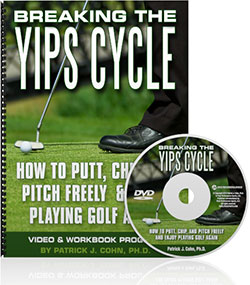
Breaking The Yips Cycle Video and Workbook program is ideal for any amateur, collegiate, junior, and tour professional golfer who wants to break out of the putting, chipping, or pitching yips.
Golf coaches and instructors would also be wise to teach “Breaking The Yips Cycle” principles to their players who struggle with tension in their swing or the full-blown yips. This program is perfect for any golfer who wants to improve performance by swinging freely again!
Frequently Asked Questions About Getting Over the Yips
How do you get rid of the yips in golf?
Dr. Cohn says there is no quick fix. His approach is mental: stop searching for the next new putter or mechanical change and uncover the fear behind the yips. First free up the stroke by overcoming fear and outcome thinking, then focus on the process instead of the outcome. For more answers, see the Golf Yips FAQ.
Why do I still have the yips after trying so many fixes?
Dr. Cohn’s answer is that you keep thinking and focusing on the yips. Working on mechanics, practicing more or switching grips are only temporary fixes that don’t address the underlying issue, and if you are not clearing your mind, negative thoughts slowly eat away at your trust in your skills.
What have golfers tried to fix the yips, according to the survey?
In Dr. Cohn’s survey, golfers said they tried telling themselves it doesn’t matter, slowing down, speeding up their tempo, taking deep breaths, working on mechanics, switching putters and grips, changing their routine, practicing more, and even stopping golf. Many of these solutions are temporary or fall short.
What is outcome thinking, and how do you manage it?
Dr. Cohn splits outcome thinking into two areas: results and aftermath. Missing a short putt is not awful; what makes it awful for most golfers is the aftermath. You have to let go of the what ifs, such as what if I miss a two-footer and look silly.
What is the “Look, Set, Go” strategy?
“Look, Set, Go” is a strategy for keeping your mind in the process. You use the steps in your routine to focus on what you are doing instead of the outcome. Dr. Cohn says the fear of missing and the aftermath is what leads you to over control the stroke and then yip.
More Yips Articles and Podcasts
- How to Reduce Chipping Yips and Free Up Your Stroke (podcast)
- Can Hypnosis Improve Your Golf Skills? (podcast)
- How to Overcome the Chipping Yips (podcast)
